
Moss Doesn't Care Which Way You Fell
IF YOU'RE LOOKING FOR HOPE...IF YOU NEED PERMISSION TO REST...IF YOU FEEL SHAME...
Queen of the Forest
7/16/20263 min read
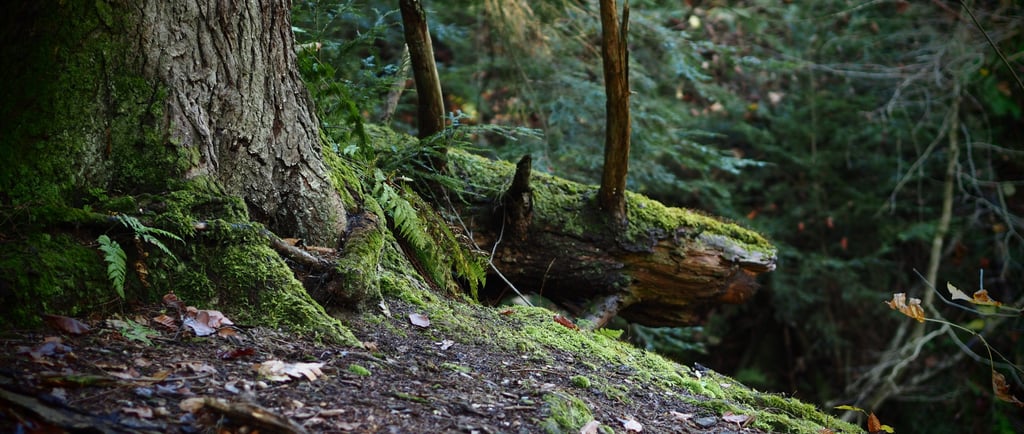
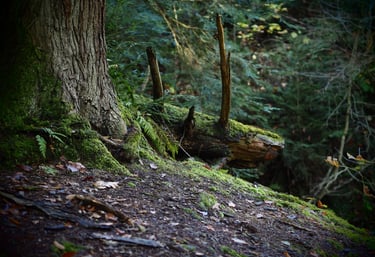
There is a kind of fallen tree that changes how you see a forest.
At first, it looks like an ending.
A trunk once upright now resting on its side, slowly returning to the earth it came from. Bark loosening. Wood softening. What stood vertical now surrendering to gravity, time, and weather.
It is easy to assume something has been lost here.
But if you stay with it, you begin to notice that nothing has stopped happening.
The forest does not step away from it.
It moves closer.
Moss begins to spread across the bark, soft and green, as though the earth is remembering how to touch it again.
Mushrooms appear in quiet clusters, shaping themselves to the contours of decay.
Insects arrive, finding shelter in the slow opening of wood.
Birds come to feed on what is now being made available.
And in the spaces where the trunk has cracked open, seedlings begin to root.
What looks like an ending is also a beginning of many small lives.
The forest does not treat the fallen tree as something that has failed its purpose.
It treats it as a place where life can continue in a different form.
There is no apology in the soil.
No hesitation in the moss.
No judgment in the fungi weaving through what used to stand apart from the ground.
Everything participates.
Even in collapse, nothing is excluded from belonging.
We often do not extend this same understanding to ourselves.
When something in us falls apart, we are quick to assign meaning to the fall.
We speak to ourselves in the language of failure.
We treat our breaking as evidence that something fundamental has gone wrong.
We assume that usefulness is tied to standing upright.
That dignity depends on remaining intact.
That value is something we lose when we fall.
But the forest does not share this logic.
A fallen tree is not erased from the ecosystem.
It becomes part of it in a different way.
It feeds what could not have grown before.
It shelters what could not have survived in the open.
It returns what it once held back into circulation.
Nothing is wasted in the way it falls.
Not even the direction.
Perhaps there is something here that quietly resists the way shame teaches us to interpret our own brokenness.
Shame says: this should not have happened.
Shame says: this has taken you out of usefulness.
Shame says: you are now less than what you were.
But the forest offers a different possibility.
That what has fallen is not removed from participation.
It is simply relocated within a wider system of life.
There are seasons in human experience that feel like falling.
Losses that change our shape.
Events that remove us from the version of ourselves we thought we would remain.
Moments where what once held us upright is no longer there.
And in those moments, it can feel as though everything meaningful has been interrupted.
But if we look closely at the natural world, interruption is rarely the final word.
It is often where new relationships begin.
Light reaching places it could not reach before.
Soil receiving what it could not previously hold.
Life adapting to what has changed, rather than demanding it be undone.
Nothing in the forest rushes to restore the fallen tree to its former position.
It does not try to make it upright again in order to make it meaningful.
It lets it become what it is now.
And in doing so, it allows an entirely new set of possibilities to emerge.
There is a kind of intelligence in that patience.
A refusal to confuse change with loss of worth.
A recognition that life continues even when form does not.
Perhaps we are not so different.
Perhaps what we call our falling is also a kind of redistribution.
Of attention.
Of care.
Of meaning.
Of possibility.
Perhaps what we imagine has ended is simply what has changed its direction of participation.
The forest does not ask a fallen tree to apologize for how it fell.
It only asks what it can become now that it has.
And perhaps, slowly, we might learn to ask ourselves the same question.