Why Forests Tend To Feel Like Home
IF YOU NEED PERMISSION TO REST...IF YOU WONDER WHERE YOU BELONG...
7/10/20263 min read
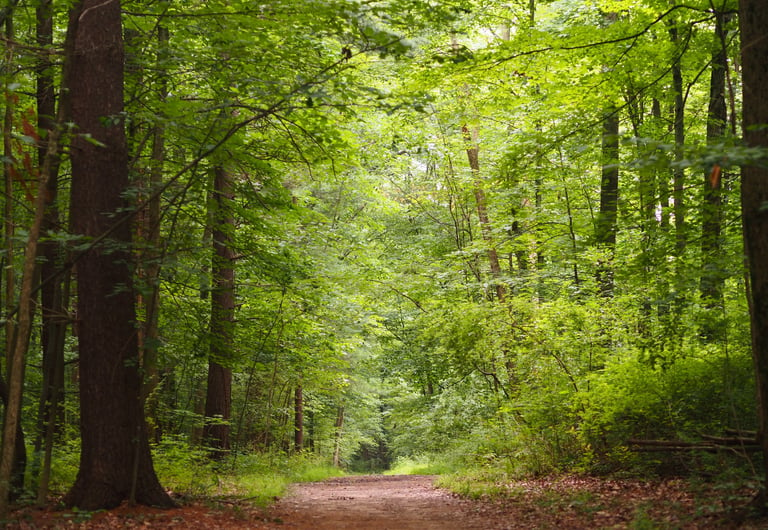
There is something that happens to many people the moment they enter a forest. The pace of thought shifts. Breathing becomes less shallow. The need to perform, explain, or hold oneself together loosens slightly. Even if nothing in life has changed, something in perception has.
It can feel surprising at first.
As if the body recognizes a place the mind has not yet named.
I have sometimes wondered why this happens.
Why forests, in particular, so often feel like home.
Not everyone experiences this in the same way, but for many, there is a quiet familiarity in the presence of trees.
It is not the familiarity of a place we remember clearly.
It is closer to something older than memory.
One possibility is that we did not evolve separate from these landscapes. For most of human history, we lived in close relationship with forests, grasslands, rivers, and open sky. The human nervous system developed not in isolation, but in continuous conversation with living environments. In that sense, forests are not "outside" us in the way modern life sometimes suggests. They are part of the context in which our senses and instincts were shaped. There may be something in us that still responds to that ancient continuity.
But there is also something simpler happening.
Forests do not demand that we be anything other than what we are. There is no expectation to speak, to impress, to justify, or to maintain a role.
No need to perform productivity.
No need to translate ourselves into usefulness.
In that absence of demand, something softens. We begin to return to ourselves without realizing it.
The forest does not rush us.
It does not interpret us.
It does not require explanation.
It simply receives us.
There is also a kind of honesty in forests that feels strangely relieving. Nothing there is pretending to be other than what it is.
A fallen tree decays openly.
A moss-covered stone simply is.
Light filters through leaves without apology.
Growth and decay exist side by side without contradiction.
Nothing is hidden away because it is inconvenient or imperfect. For a nervous system accustomed to constant evaluation, this can feel like relief.
There is no pressure to be resolved.
Only permission to exist in process.
I think part of what we call "home" is this sense of not having to edit ourselves. To be in a forest is to be in a place where nothing about you is too much or not enough.
You are not measured against comparison.
You are not competing with visibility.
You are simply one form of life among many.
Breathing.
Listening.
Being.
There is also a slower intelligence in forests that begins to affect us if we stay long enough.
Time feels less segmented.
Minutes lose their sharp edges.
Attention widens.
We notice small details we would normally pass by.
The curve of bark.
The layering of leaves.
The sound of wind moving through different heights of canopy.
The forest does not rush its own experience of time. And in its presence, we often stop rushing ours.
This slowing is not only psychological. It is physical. The body begins to follow different cues than the ones we carry in daily life.
Instead of deadlines, there are rhythms.
Instead of urgency, there is continuity.
In that shift, something in us recognizes a more spacious way of being alive.
It is also possible that forests feel like home because they remind us of interdependence. Nothing there exists alone.
Trees communicate through networks of roots and fungi.
Fallen leaves become soil.
Decay becomes nourishment.
Life is continuously exchanging with life.
There is no sharp boundary between beginning and ending.
To witness this is to be reminded that belonging is not about separation. It is about participation. Perhaps that is what we are sensing when we say a forest feels like home.
Not ownership.
Not familiarity in a narrow sense.
But participation in something larger that does not require us to stand apart in order to be included.
Of course, not every forest feels welcoming to everyone. And not every person finds ease in the same environments. Home is not a universal sensation tied to one landscape. But for many, forests offer something rare in modern life.
A place where nothing needs to be justified.
Where presence is enough.
Where being is not a problem to solve.
Perhaps that is why people return to them when they are overwhelmed.
When words feel insufficient.
When life becomes too loud.
When clarity is needed but cannot be forced.
The forest does not answer questions in sentences.
It answers in atmosphere.
In breath.
In space.
In the quiet return of attention to what is immediate and alive.
And sometimes, that is enough to make a person feel, even briefly, that they have come home to something they did not realize they were missing.